You found the timing layer the way most serious students do. A Gann reference. A McWhirter chart. A line in an old book about a 36-year world rhythm. The idea would not leave you alone. You went looking for the source.
So you read the chart harder. You marked the turns. You got the entries right more often than not. But a clean setup still failed when a war, a debt crisis, or an election changed the weather mid-trade. The chart was right about the moment and silent about the year. You were trading inside a climate you could not name.
That is the gap. The chart shows you the turn. It does not show you the climate the turn is happening inside. In 1926, a Cambridge scholar writing as Sepharial mapped that climate on a 36-year clock. He laid it out in a book most readers abandon by page ten. The method was sound. The presentation buried it. Almost nobody learned to read it, and the few who tried gave up at the coded tables. This letter is about that climate layer, and the working order that makes it readable.
A chart is a photograph of price. It is precise about the moment and silent about the era. Price structure moves inside a historical environment — war, debt, policy, national character. Read the photograph without the season and you can be right on the turn and wrong on the size, the length, and the direction of the move. The turn was real. The trade still failed, because the year was not the year you thought it was.
Most market education makes this worse, not better. It teaches you to read price harder. Technical analysis, order flow, liquidity, the whole modern stack — all of it assumes the answer lives inside the chart. So you add another indicator. You refine the entry. You study the same photograph at higher resolution. None of it tells you what kind of year you are standing in. The climate layer is not a finer reading of price. It is a different instrument, and the chart does not carry it.
There is one place that instrument was written down. Sepharial mapped it in 1926, on a 36-year clock. The trouble is the source. The book is written for occultists and Hebrew scholars who already knew the system cold. It uses coded planetary notation. It references tables that span centuries. It assumes you have internalised the Chaldean order before page one. The method survived. The way in did not. So the climate layer sits in the public domain and stays unread, because reading it is harder than the work it replaces.
The missing season shows up in four concrete ways.
You read the turn but underweight the move. A correct entry in a debt-stress year still sizes too small for the swing the era permits. The chart told you when. It did not tell you how far the year would let price travel. Same setup, different climate, and the move runs three times the size you planned for.
The chart ends where the headline begins. War, policy, and national stress sit on the other side of a boundary the chart cannot cross. You can draw every line on the candle and still be blindsided by an election or a debt crisis that reshaped the year. Those forces moved the market. None of them appear on the photograph of price.
A setup that worked in one decade fails in the next. The chart assumes the climate is fixed. The 36-year phase says it is not. The 1990s did not trade like the 1970s, and the difference was not the pattern. It was the era the pattern ran inside. Read every decade as the same weather and the method that worked last cycle quietly stops working this one.
Price is one signal. With nothing to check it against, a turn is an opinion. The world cycle is the second clock the chart never carries. One reading can be luck. Two clocks pointing at the same window is a reason to pay attention. Without the second clock you are confirming the chart with the chart, and that is no confirmation at all.
A working version reads three layers in order. First the era: the 36-year phase. Then the year: its rising sign and rulers. Then the nation: how a country's own chart meets that year. The next section is how each layer is built.
You can find Sepharial's book. You cannot find the working order. The sequence below is what turns a coded 1926 text into a reading you can run.
The book worked. The presentation did not. That contradiction would not sit still.
I spent four years with the 1926 text. It is written in Cambridge-scholar language, with coded planetary notation and tables that span centuries. Most readers abandon it after ten pages. I nearly did. What kept me was a habit: every claim the book made, I checked against the historical record before I accepted it. The book said a certain kind of era produced a certain kind of strain. I went and looked at whether it had.
It had, often enough to be worth the trouble. But the trouble was real. Each reading took an afternoon of hand calculation before I had anything to interpret. The work was all setup and no thinking. So I kept asking a different question. Not "is this true?" — the record was answering that. The question was "what is the order?" In what sequence does this book want to be read?
The day it clicked, I stopped reading the book as prophecy and started reading it as structure. The cycle is history organised as recurring timing. The order is era first, then year, then nation. Read in that sequence the coded tables stop being a wall and start being a procedure. Once I held the order, I could build the tools to run it in minutes instead of an afternoon. The work moved from calculation to interpretation, which is where the real study lives. Those tools became this course. What follows is the same order, taught the way I would teach a research partner.
Every era carries a dominant backdrop. You learn to locate the phase you are standing in and the prior periods that rhyme with it. This is the climate the whole reading sits inside. Without it you read every year as if the weather were fixed, and the weather is not fixed. Skip the era and the yearly read floats free of context. You learn to recognise the type of backdrop a phase favours — structure, conflict, expansion — before any single year is examined. That recognition is what stops you from misreading a debt-stress decade as a calm one.
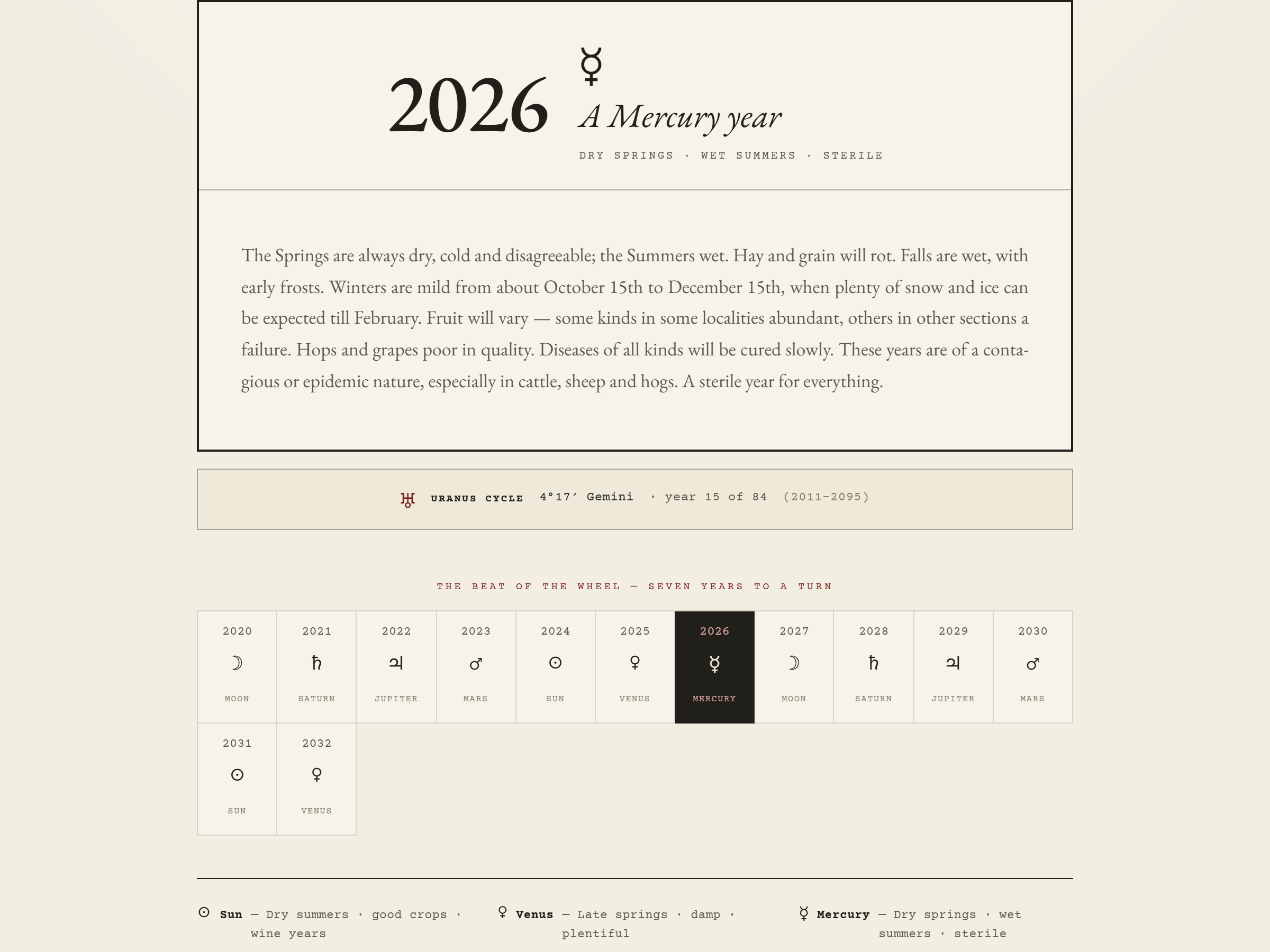
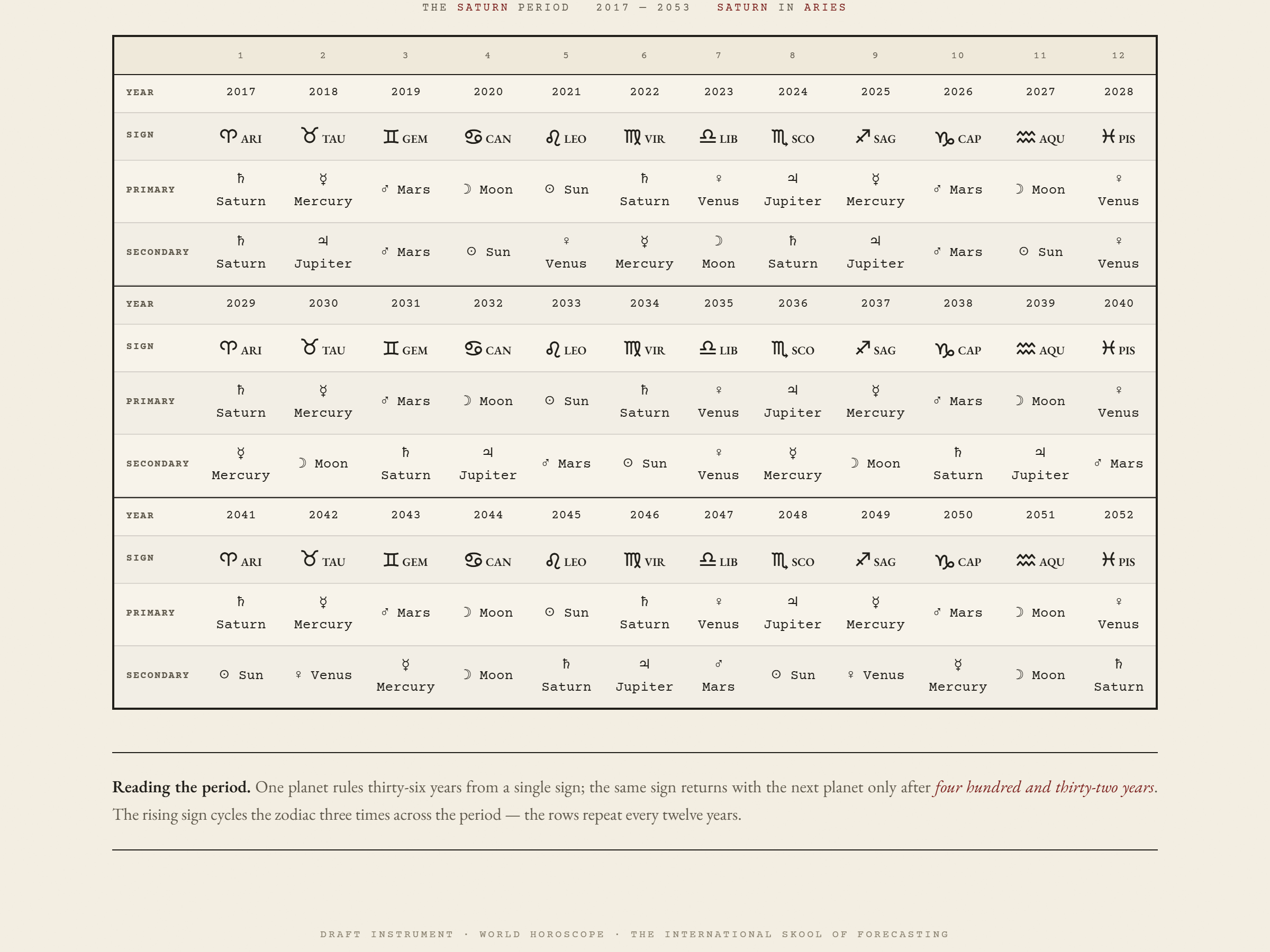
Inside the era, each year has a rising sign and a set of rulers. You learn what type of pressure they describe — structure, conflict, or expansion. This is the inherited rule, read the way Sepharial read it. The era tells you the climate. The year's rulers tell you the action playing out inside it. Without this layer the era is a mood with no events attached. You learn to recognise the kind of force a year carries, not to memorise a legend. The rules behind the legend stay in the course. What you take from this layer is the reading: this is a year that favours pressure of one type over another.
This is the layer the chart cannot reach. You combine stage and action into one reading: the theme of the year and the kind of move the era permits. It answers the magnitude problem from the broken-tool section. A chart can size a move by feel. The blend sizes it against the phase. When the era favours large structural swings and the year's action points the same way, you stop underweighting the move. You learn to recognise when the climate and the action agree, and when they pull against each other. Agreement is a year that runs hot. Disagreement is a year that stalls. That distinction is the reading the photograph of price will never give you.
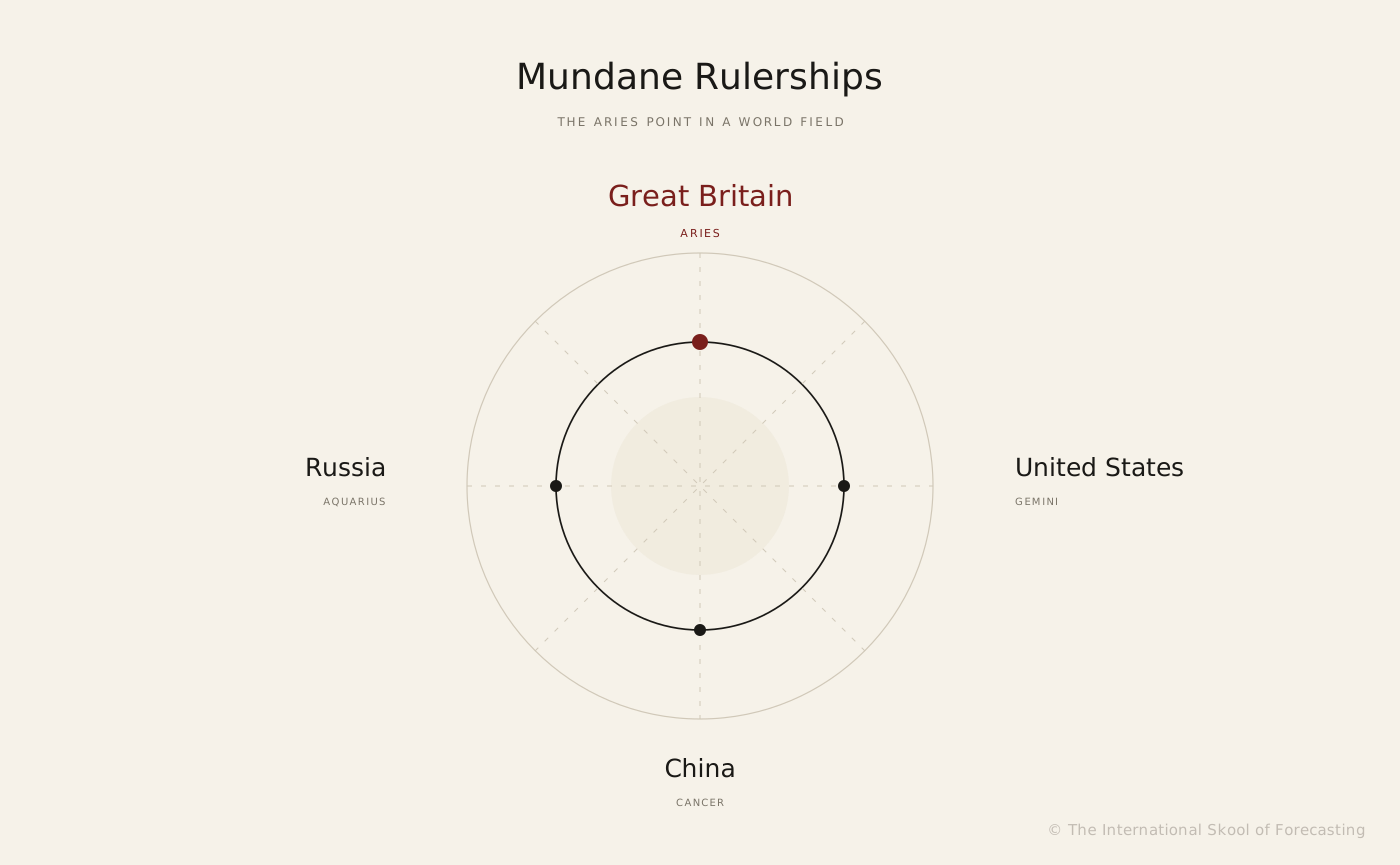
Nations have their own governing signs. You learn the spotlight check: when a year's sign matches a country's sign, that nation carries the story. When it does not, the nation reacts to the theme instead. This is where a global climate becomes a specific market. The same year does not weigh equally on every country, and the spotlight check tells you which one the year's drama runs through. Without it you treat every nation as equally exposed, and they never are. You learn to recognise when a country is the centre of a year and when it is on the edge of one. The full table of which nation answers to which sign is the product, so it stays inside the course. What you carry out is the judgement: this year, watch this country, and weight your risk accordingly.
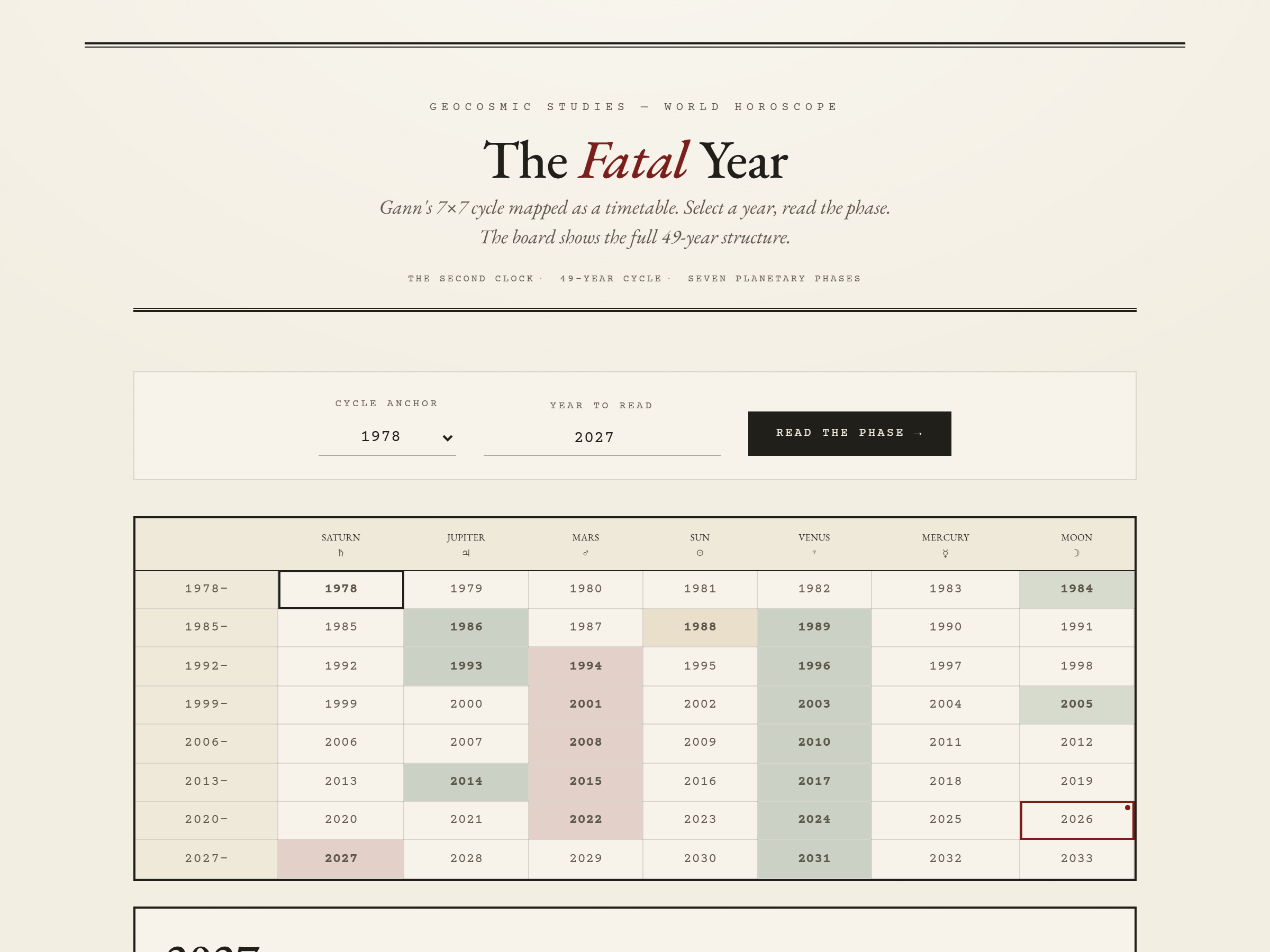
Gann's 49-year cycle runs on its own count and marks years of structural strain. You learn to read it beside the 36-year rhythm, so two clocks confirm a window instead of one. A single cycle pointing at a year is one opinion. Two independent cycles pointing at the same year is a window worth testing. This is the layer that answers the no-second-clock problem from the broken-tool section. It is also the layer most likely to be oversold, so it is taught with its limits attached. Used alone it gives a general idea and nothing more. You learn to recognise convergence — the years where both clocks agree — and to hold the rest of the time loosely. The discipline is as much about restraint as it is about the signal.
Two kinds of evidence sit below. Historical phases that illustrate how the method reads an era, and dated cases from the Skool's own record. The historical phases are illustrations, not live calls — the Skool was not publishing at the time. The dated cases are from the public record, each with a date, a market, and an outcome. Neither kind proves a future call. Both show why the framework deserves study. Read each one with its limit attached. That is how the method is taught, and it is how the proof should be read.
The cycle marks 1873, 1909, 1945, and 1981 as phase boundaries. Each sits beside a structural shift: the Long Depression, the pre-war tension, post-war reconstruction, the Volcker peak. Read forward, you can see the climate change at each boundary — a depression decade does not feel like a reconstruction decade, and the phase turn is where the feeling changes. This is offered as historical illustration of how the method reads an era. The Skool was not publishing in 1945 or 1981. It is a teaching example drawn from the record, not a call the desk made at the time. The point is the structure, not a claim of foresight.
Gann identified a 49-year pattern that marked critical transitions. Backtesting shows the Saturn-to-Saturn years — 1987, 1994, 2001, 2008, 2015, 2022 — frequently sat near major tops. This is the case most likely to be oversold, so read it with care. The clustering is genuine and it is also not a machine. The method is not mechanical. Other cycles, market character, and structure must be merged with it before any reading holds. A strain year is a window to test, not a date to trade. The course teaches the cycle with that restraint built in, because the cluster is convincing enough to make a careless reader reckless.
From the record: the desk flagged a 360-year Taiwan cycle as a geopolitical flashpoint. In August, the Pelosi visit was followed by China's largest-ever military exercises around Taiwan. The cycle work pointed to the pressure window. It did not predict war, and it did not name the event. This is the mundane-cycle method working as intended: it marked the year as one of strain over that nation, and a strain expressed itself. One case in the record, not a promise about the next flashpoint.
From the record: the desk called the worst year for stocks since 2008, with a Q1 peak and October low. The S&P 500 fell 19.4%. The Nasdaq fell 33%. The call placed the year inside a strain phase before the year confirmed it. The method does not remove risk and it did not know the whole year in advance. It read the climate as hostile and the year traded hostile. The numbers are on the record so you can check them.
From the record: the desk called recovery against the recession consensus. The S&P 500 rose 24%. The Nasdaq rose 43%. The consensus expected a recession year. The climate read pointed the other way, and the market recovered. This does not prove the next year will follow any pattern. It shows the framework reading a year that most of the room read backwards, which is the only reason a climate layer earns its place beside the chart.
From the record: the desk flagged a 120-year aviation cycle as a systemic failure risk. Boeing's crisis dominated the year. The cycle work pointed to a pressure window in a single sector. It did not name the failure or the company. The window was read first; the crisis filled it. That sequence — window mapped, then tested against what actually happened — is the whole discipline.
Some readers do not need the rest of the letter. They need the door. This is the door.
AUD $997 · One payment · Lifetime access · NDA and ID verification on enrolment
The national rulership field. It shows how the method positions nations against the year's pressure. It signals the concept the course teaches without handing over the rules behind it.
You see the word horoscope and you reach for the exit. So do I, when it is sold as fortune-telling. A serious forecaster should not accept a model because it sounds impressive. The model has to be tested against time. If it cannot survive a check against the record, it does not belong in your study, and no amount of old language saves it.
Here is what the method actually is. It is history organised as recurring timing structure. The planetary names are the labels Sepharial used; the work is the pattern they point to. A 36-year era. A yearly theme. A national chart. You compare the present phase with prior comparable phases and ask what type of developments appeared. That question is falsifiable. It is also the same question whether the year is 1945 or 2024.
Strip the old vocabulary and the procedure is plain. You are sorting history into a repeating frame and asking what tends to happen at this position in the frame. The labels could be anything. Sepharial used planetary names because that was the notation of his tradition. You could rename every term tomorrow and the method would run unchanged, because the work is in the comparison, not in the words. That is the test of whether something is timing structure or fortune-telling. Fortune-telling does not survive a rename. This does.
So the modern market does not break the method. It is one more period to read. The current phase runs to 2053, and its next inflection forms around 2027. You test the framework against that window the same way you test it against the past.
This is a timing window, not a manufactured deadline. The 36-year phase runs to 2053, and the 49-year Fatal Year points near 2027. The two clocks are converging now.
The years around 2026 to 2028 sit at an inflection inside the current phase, with the Fatal Year marker near 2027. Whatever that window brings, it is being shaped now. The reader who can already read the phase watches it form in real time.
Wait a cycle and you do not get a discount. You get the same course later, after the window you could have studied has closed and become a chapter in the record. The cost of delay is the reading you never ran on a live year.
The rules behind this reading — the rising-sign legend, the rulership table, the country charts — are the product. Pull them out of context and they become a horoscope meme that gets quoted wrong for years. A table without the method around it is worse than useless. It looks like the answer and it is only the labels. Gating keeps the work an instrument, and keeps what you paid for from being diluted into free noise. The reason the rules are not on this page is the same reason they hold their value: once they are loose, they are loose for everyone, and the student who paid for the working order is paying for nothing.
You are not buying a forecast. You are learning to read the phase yourself. Once you can locate the era, name the rulers, and run the country check, no one needs to read the year for you again. That skill stays with you for the rest of your study. A subscription rents you someone else's reading and stops the day you stop paying. This is the opposite trade. You learn the instrument once and you keep it for every year the record and the cycle reach. The cost is paid once. The capability does not expire.
Enrolment enters manual review. You submit an NDA and a verification photo — your face beside your government photo ID — through the secure portal, and a team member checks it by hand. The NDA covers no redistribution, no public teaching, and no resale. Access is released once you are approved.
The refund clause: If for any reason we cannot verify your identity, no access is released and we work with you directly to resolve it. We don't refund completed enrolments — once verified, the course is in your hands permanently, and we treat that transfer as final. The verification gate is the only point at which money moves backwards.
The parts stack. The era feeds the year. The year feeds the nation. The Fatal Year is the second clock you read beside all of it.
I was building forecasting tools when Sepharial's World Horoscope kept pulling me back. The book described a 36-year world rhythm in coded language, with tables across centuries. I wanted to use it on live markets. The text was written for occultists and Hebrew scholars, not for that. The first year I worked with it, every reading took an afternoon of hand calculation, and most afternoons ended with a result I did not trust.
So I spent four years cross-referencing its claims against the historical record. The order finally surfaced: read the era first, then the year, then the nation. The rising sign sets the stage. The rulers set the action. The country chart says who holds the spotlight. Read in that order, the book stops being prophecy and starts being structure. The tables that had been a wall turned into a procedure once I knew the sequence they were written for.
After that, I could generate a reading for any year in minutes instead of an afternoon of hand calculation. The work moved from setup to interpretation. That is where the real study lives. In the course you watch me run that order on the screen — locate the era, read the year, run the country check — so you see the judgement being made, not just the result. The over-the-shoulder work is the part no book gives you.
I teach it now because the framework is wasted in a drawer, and because most people who meet the book give up at page ten. The honest answer is that it deserves serious students, and serious students deserve the working order, not just the source. I am not handing you a forecast. I am handing you the way I build one.
You start where Sepharial started. The Chaldean order, the planetary rulers, and the shape of the 36-year framework. By the end you can read the notation the source uses instead of bouncing off it. This is the ground every later layer stands on.
You learn to locate the era you are standing in and the prior periods that rhyme with it. You compare comparable phases and ask what type of pressure appeared. The output is a reading of the climate, which becomes the input for every yearly read that follows.
You take a single year and read its rising sign and rulers. Then you run the spotlight check: does the year's sign match a nation's sign? You walk real years yourself, document the reading, and keep a record you can defend rather than a claim you take on faith.
This is the part that does not appear elsewhere in plain form. You learn Gann's 7×7 cycle as a second clock and read it beside the 36-year rhythm. It is taught with its limits attached: used alone it gives a general idea; merged with the longer cycle it earns its keep. Normally sold separately for AUD $497, it is included here.
You combine every layer into one reading: era, year, nation, and the second clock. You run it with the report generator and produce a long-range reading you keep. This is the capability you walk away with for the rest of your study.
At no-refund high ticket, the specifics are the guarantee. Here is what you can do, part by part.
The Skool keeps a dated public record across markets and geopolitics. Two more entries from it sit below. Each is dated and specific. None promises a future call.
A 360-year Taiwan cycle was flagged as a geopolitical flashpoint. That August, the Pelosi visit was followed by China's largest-ever military exercises around Taiwan. This is the mundane-cycle method's documented record, not a guarantee of any future event.
A 120-year aviation cycle was flagged as a systemic failure risk. Across the year, Boeing's crisis dominated the sector. Again, this is the method's documented mundane-cycle record; it points to a pressure window, it does not promise an outcome.
Complete checkout via the secure page. Your enrolment immediately enters manual review. You will receive a confirmation.
NDA and identity verification protect the student files and the research process. Access is released after verification is complete. If verification cannot be approved, no access is released and we work with you directly to resolve it.
Open Part 1 and the source audiobook. Then open the Google Sheet tools and generate your first yearly reading alongside the lessons. You start running the framework on day one, not after it.
No. Part 1 teaches the notation and the rulers from scratch. If you can read a calendar and follow a table, you have enough. The work is pattern comparison, not belief. You are not learning to cast charts for people. You are learning to read a historical frame and ask what tends to happen at a given position in it. The astrology label is the old vocabulary. The skill underneath it is comparison.
Because the book is the snapshot and the course is the working order. The text takes most readers ten pages to abandon. The course gives you the read sequence, the Google Sheet tools, and the audiobook, so you spend your time interpreting instead of decoding. You can spend four years cross-referencing the source against the record, as I did, or you can start from the order I worked out. The book is free. The four years are not, and the working order is what they bought.
The modern market is one more period to read. Part 3 runs the yearly reading on recent years, and Part 5 runs it forward. The same question — what type of events appeared in comparable phases — works whether the year is 1945 or 2024.
That is the common failure, and the course is built against it. Part 4 teaches the Fatal Year with its limits attached, and the whole method insists you test a phase against prior comparable phases before you trust a reading. Restraint is part of the training.
No. It issues no buy or sell alerts. It is macro context: the climate the market is moving through. It does not replace chart timing. It tells you what kind of year the chart is being read inside. Think of it as the layer above your existing method, not a replacement for it. You keep reading price. You read it inside a named season instead of a blank one. That is the whole job of this course.
It is for the student of market history who wants the widest lens, not only for professionals. If your interest is a single short-term trade, start elsewhere. If you want to understand why decades feel different, this belongs in your study.
Part 4. Gann's 49-year Fatal Year, taught as a second clock read beside the 36-year rhythm, with the backtest from 1987 to 2022 and the convergence method. It is normally sold separately for AUD $497 and is included here. You will not find the two clocks taught together in plain form elsewhere. The convergence — reading where both cycles agree — is the part I worked out, and it is the part that turns a single interesting pattern into a window worth testing.
You generate your first yearly reading in Part 3, alongside the tools. The rest extends and refines it. Lessons are self-paced, and the working files are yours for life, so there is no clock on completion.
This issues no alerts and no buy or sell calls. It is a study you run yourself. If you want someone to ping you a trade, a signal room will serve you better.
The method reads a climate, not a calendar entry. It gives you the type of pressure a year favours, not "the top is the 14th." If you need certainty before you act, this will frustrate you.
The capability lives in the readings you run, not in the videos you watch. If you will not work the framework against real years, you will leave with theory and no skill. The no-refund clause applies.
This is education, not advice. It does not account for your situation or your portfolio. If you need personal financial counsel, see a licensed professional.
This is built for you. The five parts, the Fatal Year, the Google Sheet tools, and the source audiobook. You walk away able to read the era, the year, and the nation without anyone reading them for you.
The 2017—2053 phase · next inflection near 2027
When you understand the cycle, the black swans start to look like predictable expressions of a phase you had already identified.
Enrollment process — After payment, complete a two-minute identity check via Stripe (government ID + selfie) and sign a non-disclosure agreement. Course access is issued after both are reviewed.
Strict no-refund · NDA and ID verification on enrolment.
P.S. — The World Horoscope Course teaches you to read the climate of a year: the 36-year era, the yearly theme, the nation in the spotlight, and Gann's 49-year second clock. Five parts, the tools, and the source audiobook, yours for life. AUD $997 — Enrol in the course →
P.P.S. — The current phase runs to 2053, and the Fatal Year points near 2027. The two clocks are converging now. Learn to read the window while it forms, or read about it after the record is written.
P.P.P.S. — This is study, not a signal feed. If you will not work the framework against real years, it will not serve you, and the no-refund clause applies. If you want to read the climate yourself and keep that skill for life, you already know this is for you.