Feb 2020 · Mid-March low flagged The window · Marked months ahead AUD $2,997 · One payment · Lifetime
Enrol →
A personal note on what the method actually is, and who it is for

Price tells you the turn happened. Solar-degree timing names the window before it does.

What follows is the case for a course on W.D. Gann's solar-degree method — written for the trader or researcher who has already learned that price is late, and who wants the timing layer that sits above it. It is not for everyone. It is for the one who will do the work.

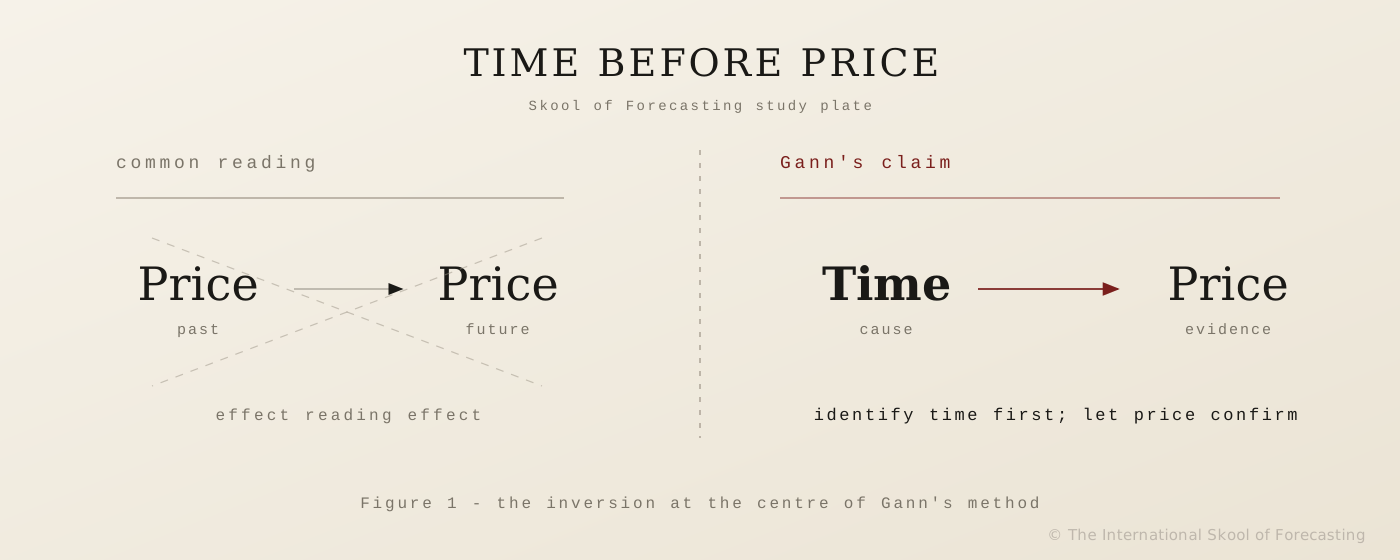
Most traders study price after it has moved. The chart shows the turn once the turn is already in. By then the easy money is gone and the risk is high. Solar-degree timing works the other way around. It studies time first. It names a window — a short period when the market is likely to change trend — and it names that window months in advance. You watch price for confirmation inside the window. You do not chase it.

The window is not a magic date. It is a probability zone. Reversals that fall inside it carry weight. Reversals that miss it move to the next one. This letter explains what the method is, why the old source is hard, what the course teaches you to recognise, and what it will not promise. The price is one number, plainly stated. The work is real work. Read it slowly.

A note on the tone of what follows. This letter is not a sales pitch. It is a working document. The product — if we end up in the same place — is described accurately. The method is described accurately. The price is one number, plainly stated. The work you will do is real work, with a real verification gate before access is granted. If that offends you, this is the wrong place.

Picture the trade you remember most. The one where the market turned and you were a week early. Or a week late. You had the direction right. You read the chart, you sized the position, you waited. The turn came — but not when you thought it would. So you sat through a drawdown you did not need to sit through, or you took the entry too soon and got stopped before the real move began. The loss was not in your analysis. It was in your timing.

Every serious trader has that trade. Most have a stack of them. The pattern is always the same. The direction was readable. The week was not. Price told you the trend. It did not tell you the date.

Price is a record of what already happened. By the time the chart confirms a turn, the turn is behind you. The forecaster's question is the opposite one. Not "what just turned" — but "when is the next turn due."

W.D. Gann left the answer to that question in plain sight, and then he buried the working form of it. The central idea is simple to state. The sun moves through the year at a changing speed. It runs faster in some seasons and slower in others. The market's highs and lows fall on dates that recur — but the dates drift a little each year, because the sun's speed drifts. A flat day count cannot hold this. Thirty days, sixty days, ninety days — those counts are approximations, and the error builds every season until the count falls out of line with the market. A reading anchored to the sun's true position does not drift. When the sun returns to the position it held at a prior major turn, the market reaches a sensitive time window. That is the claim. It is testable. The record shows it deserves study.

Gann said it plainly in his own books. "Time is the great factor that proves all things." He meant it as a working instruction, not a slogan. He studied the time condition first, then watched price for confirmation. That order is the whole edge. Reverse it — read price first, look for time after — and you are back to chasing the move once it is already obvious.

The idea is the easy half. The hard half is the reading — telling a strong window from a weak one, handling the seasonal gates, and letting the moon and eclipses narrow the months to watch.

That working form does not appear in print. Gann wrote it into old prose and parable, scattered across Tunnel Through the Air and The Master Stock Market Course, encoded on purpose so that a casual reader would pass over it. He gave the philosophy. He withheld the procedure. A hundred readers have interpreted the same passages a hundred different ways, and most of them are wrong, because the source was written to be misread by anyone who had not done the work.

I have done the work. More than a decade of reading, testing, and refining the source against real charts. This course is the working form, taught by hand, the way it was taught to the small number of students who came before you. Jonathan Evans has said it directly inside the program: this method is not taught in books, videos, or public courses, and in over ten years it has been shown to perhaps forty or fifty people. This letter is the case for becoming one of them.

§ The problem

Why nobody learns this on their own. The source is coded. The modern toolkit is blind to time.

There are two reasons the timing layer stays out of reach. One is old. One is new. Together they explain why a method this useful is still rare.

The old-source problem

The material exists. It sits inside Gann's books, where anyone can buy them. So why can almost nobody use it? Because the source was built to resist a casual reader, and time has made it harder still.

It is hidden inside century-old prose and religious parable. Gann wrote the timing work into passages that read, on the surface, as story and scripture. A modern reader without a guide skims past the instruction and never sees it. The framework is there. The mechanics are not. Gann gave the philosophy of why time governs markets, and he withheld the calculation sequence that turns the philosophy into a date.

It has no bridge to a modern chart. Even the rare reader who decodes a passage cannot translate it to a trading platform. The source assumes tools and habits that no longer exist. And because Gann encoded the method on purpose, it has been interpreted a hundred ways by a hundred practitioners — most of whom guarded their reading, taught no one, and left no public trail. The interpretation is the product. Without it, the books are a locked door.

Gann gave the framework and withheld the working form. A hundred years later, the framework is public and the working form is still rare. That gap is the whole reason this course exists.

The modern-market problem

Now set the old books aside and look at what a serious trader studies today. Technical analysis — price patterns, read after price has moved. Fundamentals — earnings and macro data, the slowest layer of all. Sentiment and order flow — a map of where money went yesterday. Each of these is real work. Each of them is useful. And not one of them tells you when the next reversal is due.

They all react. They describe the move after it has started. That is why the same mistakes repeat, year after year, in the accounts of people who are not careless and not new:

You enter a trend too early and burn capital on whipsaws while you wait for the real move. You exit a winner too soon and watch the profit you left on the table double without you. You chase a move that is already ten or twenty percent extended, because by the time it looked obvious it was already late. You hold a loser into a reversal that the timing layer would have flagged weeks earlier.

The timing layer sits above price. It moves first. But nobody teaches it, because it was never popularised — and the cheap substitute, simple calendar counting, fails for a reason most traders never diagnose. A thirty, sixty, or ninety-day count assumes the earth moves at a constant rate around the sun. It does not. The orbit is elliptical. The sun's apparent speed changes through the year. So the flat count drifts, season by season, until the dates it produces no longer line up with the market. The serious forecaster needs the sun's true position, not an approximation that quietly accumulates error.

That is the gap this course closes. It teaches the working form Gann withheld, and it bridges it to the chart you actually watch. The next section is what that working form contains.

§ The method

One method, worked end to end. A timing skill you keep for life.

You are not watching a video series. You learn to read a window, test it against the chart, and mark it in advance. Each unit adds a tool to the same craft, and the units build in order. The first gives you the way of thinking. The last shows the whole craft worked on a real year, over your shoulder. What follows is what each unit teaches you to recognise — not the counting procedure, which is the part you do by hand inside the course.

Unit One · Time by Degrees

This is the foundation, and it is mostly unlearning. You start by seeing exactly why price is late, and why the flat day counts you may already use drift out of line as the sun changes speed through the year. Then you learn what a solar-degree window actually is — a short period where seasonal rhythm and the sun's position line up with prior swings — and, just as important, what it is not.

Why it matters. Most people who fail with timing fail here, before they begin, because they treat a turn date as a magic day on the calendar. It is not. It is a window, and a window is a probability statement. Get this wrong and every later unit becomes superstition. Get it right and the rest of the course is just craft. What you learn to recognise: the difference between a date the market must obey and a window the market tends to respect. You leave with a working vocabulary and the right way to think about a turn.

Unit Two · Counting with Time

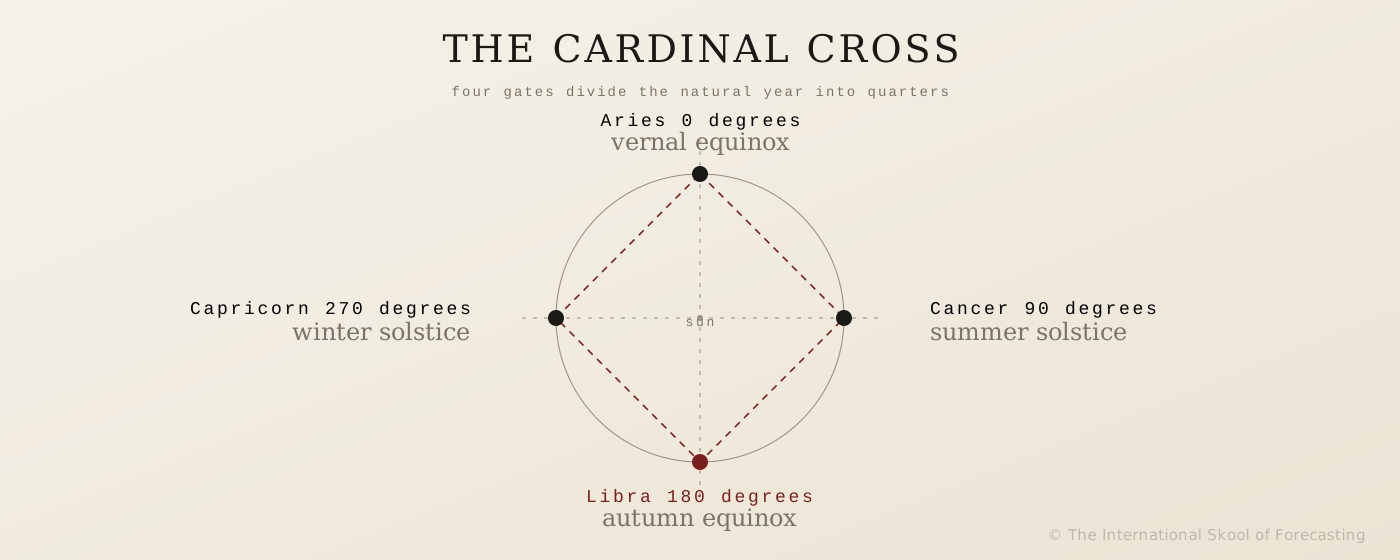
The four cardinal gates of the year — the spring and autumn equinoxes, the summer and winter solstices — and how major swings cluster around these seasonal hinges. These gates divide the market year into quarters, and the character of the market changes as it crosses from one quarter to the next. You learn to carry a prior high or low forward to the months worth watching.

Why it matters. A window with no frame around it is just a guess. The cardinal gates are the frame. They tell you which windows sit at the strong seasonal hinges and which fall in the dead middle of a quarter where the market is less likely to listen. What breaks without it: you treat every window as equal, you act on weak ones, and the method's accuracy collapses under the false signals. What you learn to recognise: a strong seasonal window from a weak one — and the discipline to test the reading against current structure rather than trusting it blind.

Unit Three · The Lazy Man's Signal

The chart-only way to mark repeating turn dates without an ephemeris. You learn to read the same dates recurring across markets, month after month, using nothing but the chart in front of you and your own eyes. Jonathan calls it the simplest thing in the program and the one most students end up valuing most. He has said he has never taught it anywhere else, and that if you did nothing in the whole program except learn this one technique, you would still carry a greater edge than most of the people you trade against.

Why it matters. The deeper method takes study. This one takes minutes, and it works as a standing reality check on everything else. Once you mark the highs and lows going back across a year, the same dates start to surface — and they surface across every instrument you look at, not just the one you traded. What you learn to recognise: the repeating turn dates that were always on your charts and that you never saw. As Jonathan puts it, once you see this, you cannot unsee it. That is not a sales line. It is what students report.

Unit Four · Eclipses and Moon Phases

How lunar timing layers onto the solar window to narrow the months and weeks of highest probability. Important tops and bottoms often fall near eclipses, and a solar or lunar eclipse can mark a change in the market that a price chart only confirms afterward. You learn to read the moon as a second, independent clock running over the top of the solar one.

Why it matters. This is confluence, and confluence is the heart of responsible timing. When two independent layers — the solar window and the lunar cycle — agree on the same period, the reading carries more weight. When they disagree, you stand down. What breaks without it: a single layer gives you too many windows and no way to rank them; you act on all of them and the noise drowns the signal. What you learn to recognise: the weeks where the layers stack, which is where the highest-probability turns live. This is not a second opinion bolted on. It is built into the reading.

Unit Five · The Case Study

The 2024 Dow Jones, worked over your shoulder across a full year. You watch the turn dates tracked month by month, see which dates gave tops and which gave bottoms, and learn to read when a market is building toward a major turn. When turn dates start piling up on tops, the chart is telling you a major top is forming — it might not be this month, but it is coming. That is the kind of reading the case study trains.

Why it matters. Theory without a worked year leaves you with a vocabulary and no instinct. The case study is where the instinct forms. What you learn to recognise: a healthy market that bottoms on its turn dates versus a market rolling over that tops on them — and you learn it the honest way. Not every call in the year was right. Jonathan shows the misses alongside the hits, because the point is the work shown, not a clean highlight reel. You see swing high and swing low calls that no signal service would ever show you, and you see where the method had to defer to structure.

§ Before and after

From reacting to price. To planning the year around the window.

Before the course

You enter early because you do not know which week the real move begins.

You hold winners too long because you cannot see when they are due to roll.

You lean on price signals that lag by days or weeks.

You react to news you did not anticipate, and feel a step behind the room.

Your backtests look fine, but forward-testing fails — because you have no forward-looking calendar.

After the course

You know months ahead which windows are likely to turn the market.

You plan the calendar backward — mark the windows first, then decide when to be active.

You test your other analysis against the calendar instead of running it blind.

You read whether a market is healthy or rolling over by where its turns are landing.

You merge timing with structure — solar window, lunar confluence, support and resistance — into one reading.

The shift is not that you suddenly predict the future. It is that you stop being surprised by the calendar. The turn was always coming. After the course you knew the window it was coming in, you watched price confirm it, and you acted with the position already planned. That is the entire difference between a forecaster and a reactor. One studies time before the move. The other studies price after it.

§ Proof walk · The study plate

The cardinal cross. The four gates that divide the market year.

The plate shows the cardinal cross of the solar year. Four gates divide the year into quarters: the vernal equinox, the summer solstice, the autumn equinox, the winter solstice. Major swings cluster around these seasonal hinges. The course teaches you to read a market against this frame, then carry a prior turn forward to the months worth watching.

The frame is what you build. The record below is what the reading has produced when it was applied with care. None of it is a guarantee. It is dated, specific, and restrained on purpose — evidence that the timing layer deserves study, not a promise about the next window.

The cardinal cross of the solar year — the four seasonal gates that divide the market year into quarters.

2020 · The mid-March low

In February 2020, the forecast identified a mid-March low. The COVID crash reached its market low on March 23. The recovery path that followed into August was also described. This does not prove certainty. It shows why the timing method deserves study. The window was named before the panic, not after it — which is the only test that matters for a forecasting method.

2022 · Gold to the dollar

The 2022 gold forecast used a harmonic target near $1,621. Gold later reached an actual low of $1,620.32. The number is offered plainly, with no claim of a perfect prediction. A target near a level the market then touched within a dollar is a specific, checkable result. Specific numbers do the work here. Adjectives would only weaken it.

2024 · The Dow Jones, worked in full

This is the case study you watch inside the course, and it is the most honest piece of proof on this page — because the work is shown, not just the result. Across 2024, the daily turn dates are tracked through the year. You see which dates gave tops and which gave bottoms. You see how a cluster of turn dates landing on tops signals a major top building. You also see the calls that did not land. Not every single call was correct. What you take away is the reading itself: how a market tells you, through where its turns fall, whether it is healthy or rolling over. No signal service shows you the swing high and swing low formations the way this study does.

2025 · Gold, again

Mars-Cancer timing was specified in advance. Gold set multiple all-time highs in the weeks that followed. The timing layer matched; market structure provided the confirmation. As with every item above, the honest framing is the same — the method maps the window, and the market either respects it or it does not. The record shows it has respected it often enough to be worth the study.

Read the record for what it is. Four dated examples, stated without exaggeration, with the misses left in. That is the standard a research desk holds itself to. A guru page would promise more and prove less.

If the method is what you came for, you have it.

One payment. Lifetime access. Strict no-refund. NDA and ID verification on enrolment.

Enrol — AUD $2,997
§ How it is taught

Not a theory handed over. The method worked, in front of you.

There is a way to teach this badly. You explain the philosophy, hand over a list of rules, and leave the student alone with a chart and a hope. That is how most Gann material has always been taught, and it is why most Gann students never get past the books. The rules sound right. The reading never comes.

This course is built the other way. You are shown the method being worked, not handed a theory and left alone. Every concept arrives attached to a real chart, marked in real time. When Jonathan reads a window, you watch the window get read. When a date gives a top, you see the top form on the date. When the moon and the solar window agree, you watch the agreement narrow the reading from a month to a week.

The spine of the apprenticeship is the 2024 Dow study. It is not a slide. It is a year of a real market, walked date by date, with the calls and the misses both on the table. You sit at the desk while the work is done. By the time the year closes, you have not just learned the rules — you have watched a forecaster apply them under live uncertainty, defer to structure when structure disagreed, and read the market's own turns as a running report on its health.

A theory tells you what should happen. An apprenticeship shows you what to do when the market does something else. This is the second kind.

Behind the desk is more than a decade of reading, testing, and refining the source work. This is not a collection of Gann quotes assembled into a course. It is a working research tradition, taught by someone who has spent the years it takes to make the source usable. The value is in the interpretation, the application, and the review — the three things the books leave out and the three things you cannot get on your own.

§ The offer

What you pay · What you build · What it costs you to walk away.

The course is the artefact. Everything else is the exchange rate. Three numbers decide whether this is a good trade for you: what you build, what you pay, and what it costs you to walk away without it.

What you build. The skill to read a turn window by hand, months ahead, for any market you watch. By the end you can mark the four seasonal gates, carry a prior turn forward to the months worth watching, sharpen the reading with the Lazy Man's Signal, and narrow it with the moon and eclipses. The skill is yours. There is no subscription, no renewal, and no dependency on Skool of Forecasting once you have it. You re-run the same reading on every future cycle, on equities, indices, currencies, and commodities alike, because the method scales across markets and timeframes.

What you pay. One payment. AUD $2,997. Lifetime access after identity verification and a signed NDA. This is a strict no-refund program, and that is stated up front rather than buried — because a research program of this kind has to treat the transfer of the method as final, and you should decide with that in full view.

What it costs you to walk away. The next window arrives whether you can read it or not. It always does. The question is only whether you read it before it opens or recognise it afterward in hindsight. A trader who learns to read the window once carries that skill for the rest of a research career — every year, every market, every cycle. Walk away and you keep paying the old tax: early entries, late exits, chased moves, and turns that surprised you when they did not have to.

The five units · what each one leaves in your hands

  • Time by Degrees — the way of thinking about a turn as a window, and the working vocabulary that keeps you from treating a date as magic.
  • Counting with Time — the four cardinal gates and the skill to tell a strong seasonal window from a weak one, tested against current structure.
  • The Lazy Man's Signal — the chart-only reading of repeating turn dates, with no ephemeris required, that works as a standing check on everything else.
  • Eclipses and Moon Phases — the lunar layer that narrows a month to a week through confluence, so you act where the layers agree.
  • The Case Study — the full 2024 Dow Jones year, walked over your shoulder, calls and misses both, until the reading becomes instinct.
  • Lifetime access — every unit, every future refinement, re-run on any cycle for the rest of your research life. One payment. No renewal.

The tools you need to do the work are free. A free online ephemeris is the working tool used throughout, and the lessons walk you through setting it up. The Lazy Man's Signal needs no ephemeris at all. There is nothing to buy beyond the course, and nothing to keep paying for once you own it.

Set that against the market it sits in. Astro-timing and forecasting services of this kind are sold by subscription — often four figures a year, renewed for as long as you watch the market. Specialist forecasting courses run from the high hundreds to several thousand dollars. This is AUD $2,997, paid once, with lifetime access and every future refinement included. The contrast is plain: rent a forecast feed by the year, forever — or own the reading once, for life. You learn to mark the window yourself, on a free tool, and no one needs to mark it for you again.

§ Why this is gated

A small room, kept small on purpose.

The idea sits in W.D. Gann's work, written in old prose and parable that most readers cannot parse alone. What is not in print is the working form — how to read a window, tell a strong date from a weak one, and let the moon and eclipses sharpen it. That working form took more than a decade to assemble against real charts. It is the product.

If that working form were handed out openly, the edge would thin for everyone who did the study. A method that names a turn window works in part because few people are reading the same windows. Publish it to the open market and you weaken it for every student who paid to learn it in full. So the gate is not theatre. It protects the thing you are buying.

This is why Jonathan has only ever taught the method to a small number of people, and why he asks that the group stay close — that students not explain the methods or the calculations used to reach the conclusions. Public exposure weakens the advantage. Keeping it private is what keeps it effective, year after year.

When you enrol, you verify your identity and sign an NDA covering the course materials and the method. A person reviews each submission by hand. The verification does two things at once. It keeps the room serious — students, not scalpers reselling the method into a signal feed — and it confirms that the people inside are there to study. If verification cannot be approved, no access is released, and we work with you directly to resolve it.

The refund clause. This is a strict no-refund program. Enrolment is final once you complete checkout. The verification step protects the method and the community, not your right to a refund — if verification cannot be approved, no access is released and we work with you directly to resolve it before any access opens. Read the terms before you enrol, because once you are in, the research is in your hands and we treat that transfer as final.

§ Fit

Who this is built for. And who it will only frustrate.

Built for

Traders and investors who study price after it moves and want the timing layer that moves first. Cycle researchers who already know Gann's name but cannot get from his theory to a working method. Serious students willing to spend a few weeks learning, testing, and drilling the reading before they trade it forward. Anyone who backtests their analysis and wants a forward-looking calendar to lay on top of it. Researchers who want a structured method and the discipline that comes with it — not a feed of alerts.

If you can read a chart and use a free ephemeris on a website, you have the prerequisites. You do not need an astrology background. The course teaches the astronomy from first principles as you go.

Not for

Anyone seeking buy and sell alerts. This teaches the calendar window, not the execution, and there are no daily signals — the method is for the trader who wants to do the work themselves. Anyone who needs certainty before acting; these are probability windows, not guarantees. Anyone looking for a quick trading hack, or expecting to automate the reading with no learning curve. Anyone who has not yet read the free library essay on solar ingress, which is the natural first step.

And anyone unwilling to verify their identity or sign the NDA. Both gates are non-negotiable. They are what keeps the room serious and the method worth learning. If either gate is a problem, this is the wrong program, and that is better to know now.

§ Common questions

The honest answers.

Is AUD $2,997 worth it for one method?

That is the right question to ask, and the honest answer is that it depends on what the skill replaces. The method is not a one-year subscription you re-buy every December. It is a reading you own for life, re-run on any market and any cycle for the rest of your research career. Set the price against the cost of the problem it solves — the early entries, the late exits, the chased moves — across that many years, and the arithmetic changes. If you only want to test the idea once and move on, this is too much to pay. If you want the timing layer permanently, it is one payment for a skill that does not expire.

Does a hundred-year-old method still work in modern algorithmic markets?

It works on a horizon the algorithms do not trade. Quant and algorithmic strategies compete over milliseconds to days, training on recent price action. The solar-degree window operates on a seasonal and annual horizon that no short-term model is built to hold. The edge is not speed. It is time-scale. A reading that names a turn window months ahead does not compete with a model timing the next few minutes. They work on different layers of the same market. The 2024 Dow study and the dated record on this page are recent, not historical curiosities.

What if I don't know anything about astrology?

You don't need to. The course teaches the astronomy from first principles as you go. If you can read a chart and use a free ephemeris on a website, you have the prerequisites. The case study is a worked example — you can follow the reading before you grasp every variable, then build back up to it. Nothing in the method asks you to believe anything; it asks you to test a window against the chart and judge the result for yourself.

What if I don't have an ephemeris?

You don't need to buy one. A free online ephemeris is the working tool used throughout the course, and the lessons walk you through setting it up. The Lazy Man's Signal goes further — it lets you mark repeating turn dates from the chart alone, with no ephemeris at all.

How is this different from the McWhirter method / FTT / other Skool courses?

The Skool teaches each method as its own discipline. Solar-degree timing names a turn window from the sun's position and the chart's own rhythm. The McWhirter method works the lunar business cycle. The Financial Time Table reads the long economic tide. They are complementary, and the Skool teaches them as separate courses so each can be learned deeply. This is the solar-degree one. It stands alone, and it is also part of The Market Forecaster bundle if you want the full set.

Can I use this for intraday trading, or only daily and weekly charts?

Both. The method works on any timeframe because the reading scales. A student who can read a daily window applies the same thinking to a shorter chart, and the same to a weekly one for position work. The course teaches the principle; you adapt it to the chart you watch. The case study runs on the daily Dow, which is the cleanest place to learn the reading, and the skill transfers down or up from there once it is solid.

What if I already use a different astro-timing service?

The course is most useful to you, not less. You learn why the method works the way it does, so you can read the window yourself rather than wait on a third-party feed. The student who finishes the course owns the skill. The service you use now can be checked against, or replaced by, the work you do yourself.

What if I don't like the course?

This is a strict no-refund program, and enrolment is final once you complete checkout. The research is in your hands the moment access is released, and we treat that transfer as final. If verification cannot be approved, no access is released and we work with you directly to resolve it. Read the terms before you enrol. This is the honest way to gate a research program of this kind.

How long does the course take?

Self-paced. Plan on a few weeks of part-time study to watch the material, work the examples, and start testing windows on your own charts. There is no time limit — access is lifetime after verification, so you can return to a lesson whenever a live window calls for it.

What does the method not promise?

It does not promise a result. The method identifies timing conditions. It does not remove risk, and it does not tell you whether to buy or sell at any point — that is your judgement, applied with structure and risk management. A turn date is where the market tends to reverse, not where it must. Strong one-directional markets can run through a window for several days before they listen. Eclipses and lunar timing add confluence, not certainty; layering more agreement reduces false signals, it does not guarantee accuracy. The student still has to study, test, and judge. That boundary is stated plainly because the method is more useful to someone who respects it.

Who is this not for?

Traders looking for a signal service. Students who have not yet read the free library essay on solar ingress. Anyone who wants daily buy or sell alerts — we do not provide them, and the method is for the trader who wants to do the work themselves. Anyone who needs certainty before acting, or expects to automate the reading with no learning curve. And anyone unwilling to verify their identity or sign the NDA. Both gates are non-negotiable.

§ The decision

One payment. One method. Lifetime ownership.

The next turn window is already on the calendar, whether you read it or not. The only question is whether you read it before or after. The course is most useful the day you finish it — the work you do before a window is what gives you the standing to act when it arrives.

There are two kinds of trader. One reads price and reacts to what already happened. The other studies time and prepares for what is due. They can look at the same chart and see two different things — one a record of the past, the other a calendar of the year ahead. This course moves you from the first kind to the second. Not by promise. By skill you build and keep.

If you have read this far, you are already the kind of person this is for. You did not come for alerts. You came to understand the layer that sits above price. The door is open, the terms are plain, and the work is yours to do.

AUD $2,997
One payment · Lifetime access

Enrollment process — After payment, complete a two-minute identity check via Stripe (government ID + selfie) and sign a non-disclosure agreement. Course access is issued after both are reviewed.

Enrol — AUD $2,997

Strict no-refund · NDA and ID verification on enrolment

P.S. The next window is on the calendar. The trader who can read it before it arrives has the tool in hand the day the market turns. The trader who waits learns the same window in hindsight, from the chart, after the easy money has gone. The whole course is about which side of that line you stand on.

P.P.S. The Lazy Man's Signal alone changes how you look at a chart. It needs no ephemeris and takes minutes to apply. Once you see the same dates recur across every market you watch, you cannot unsee them — and that one reading runs as a permanent check on everything else you do.

P.P.P.S. Read the record on this page for what it is. A mid-March low named in February 2020. A 2022 gold target near $1,621 against an actual low of $1,620.32. A full 2024 Dow study with the misses left in. Gold's 2025 highs after the timing was set in advance. None of it is a guarantee. All of it is dated, specific, and restrained. That is the standard a research desk holds, and it is the standard the method is taught to.

P.P.P.P.S. One payment. AUD $2,997. Strict no-refund. NDA and ID verification on enrolment. Access is released once verification is complete. This is educational research only. It is not financial advice and does not recommend any position. The method identifies timing conditions; it does not remove risk, and you still have to study, test, and judge.

Time by Solar Degrees — Read the turn window months ahead. One payment. Lifetime access.
Enrol — AUD $2,997