Most researchers subscribe to a forecast and read what someone else decided. The serious forecasters did the opposite. They built the year-ahead roadmap themselves, from the historical record up — and they studied time before the move became obvious. W.D. Gann published annual forecasts that covered the year ahead in politics, weather, agriculture, and the NYSE, month by month. He sold the forecasts. He never sold the method that built them.
The method I rebuilt flagged a 120-year aviation cycle as a systemic failure risk for 2024. Boeing's crisis dominated the year. That call did not come from watching price. It came from the look-back ladder and the mass pressure chart — the same tools you build in the first chapters of this course, applied to the year ahead. It is one case among the documented record, and evidence the method deserves study, not a promise of what the next year holds.
Gann compiled the Financial Time Table in 1908 — one published artefact. The mass pressure chart he used to lay multiple cycles into one reading is another. But the full workflow — the look-back ladder across overlapping horizons, the event-clustering research, the chart construction, the report — was never documented in one place by Gann or by anyone since. I rebuilt it from the source. Each December I sit down and build a full year-ahead forecast across politics, the economy, weather, the NYSE, gold, and the Australian market. The build takes weeks.
This course teaches the full method. Across seven chapters — including a complete worked example where I build my actual 2025 forecast on camera — you set up the Forecast Roadmap spreadsheet, run the look-back ladder, cluster the year's themes, layer the cycle stack, construct your mass pressure chart, and write the report yourself. By the end you have built your first one. Then you do it again every December for the rest of your research life.
Finished forecasts circulate widely. You can buy one, read it, file it away. What has never existed — anywhere — is a documented workflow for building one yourself. The forecast was always the output. The method that built it was never published as a method.
That gap shows up in four concrete ways.
Most researchers subscribe to someone else's forecast. The report arrives by email or post. You read it. You can't verify how it was built. You can't extend it. You can't write your own. Every year the subscription renews. Every year the cycle is someone else's, not yours.
Researchers who do study cycles themselves usually pick one — the 18.6-year North Node, or the decade cycle, or Benner. They run that one cycle and call it a forecast. Gann's forecasts layered fifteen cycles. A single-cycle reading misses every place the layered picture contradicts the line.
Even researchers who know about every cycle don't have a workflow for combining them. Which cycle weighs more at this phase? How do you read clustered turning points? When does one cycle invert? Gann had answers. He didn't publish them as a process. Without the process, you have ingredients and no recipe.
No published Gann researcher has shown the full workflow from raw historical data to finished annual report. Books explain pieces. Courses teach individual cycles. Nobody sits down and builds a forecast from scratch, on camera, while you watch. You are left to synthesise alone.
A working forecast methodology needs four things in sequence: a research process that surfaces the year's themes from the historical record, a layered cycle stack that combines into one reading, a synthesis tool that turns the stack into a forecast curve, and a complete worked example so you see the workflow end to end. The next section is how each works.
Gann published forecasts. He never published the workflow that produced them. In this course I assemble that workflow for you — from the look-back research process, through the layered cycle stack, through the synthesis tool that builds the forecast curve, to the complete worked example.
The forecast existed. The method to build one didn't.
I started studying Gann's published forecasts in detail more than fifteen years ago. Each one is a remarkable document — a full annual outlook covering politics, weather, agriculture and the NYSE, month by month. What none of them included was the method that produced them.
Gann scattered pieces of the method across his books. Chapter 7 of the Master Stock Market Course names the master time factor as his greatest discovery. The 1908 Financial Timetable shows the 18.6-year backbone. Frank Adam's later work covers the decade cycle. But nowhere — not in Gann's own writing, not in Phil Anderson, not in Daniel Ferrera, not in any Gann-tradition book I have read — does anyone show the full workflow from raw historical data to finished annual report.
I rebuilt it from the source. I sat down with the Master Stock Market Course, the published forecasts, and a modern ephemeris. I worked out the look-back research process. I layered the cycle stack. I automated the Mass Pressure Chart in a spreadsheet. I produced my first publishable annual forecast in 2017, and one every December since. This course is the workflow, taught the way I'd teach it to a serious research partner.
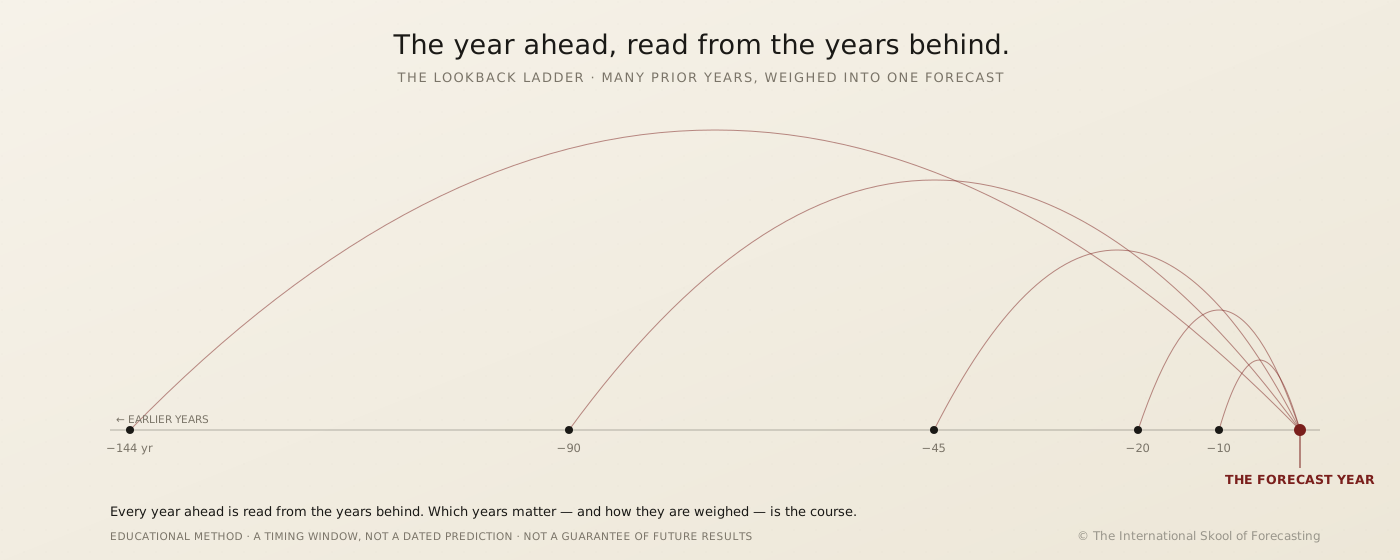
The forecast starts with research, not with cycles. Gann's annual reports opened with a structured look at what had happened in equivalent historical periods. I teach the same workflow — how to identify next year's likely themes from the documented historical record, across politics, weather, agriculture and economics. You finish this layer with a structured research file for the year ahead.
From themes into the market. This is where the layered cycles enter — the long-period economic cycles published by Benner, Armstrong and other established researchers, alongside the planetary cycles Gann embedded in his work. Each cycle gets walked against the Dow record back to the eighteenth century. You learn which cycles to weight at which phase and how their layered reading differs from any single-cycle line.
Gann's ten-year roadmap. Frank Adam called it the greatest discovery Gann ever made. Each year of the decade carries a characteristic pattern in price and economic activity — distinct enough that the pattern is readable on the Dow record going back to 1900. You anchor each new forecast to the position of the year ahead within this ten-year roadmap.
The 18.6-year economic timetable Gann compiled in 1908. This single cycle sets the macro phase context — where in the long economic cycle the year ahead sits. (My standalone Gann Financial Time Table course covers this cycle in deep detail. Here it slots into the larger workflow as one input among many.)
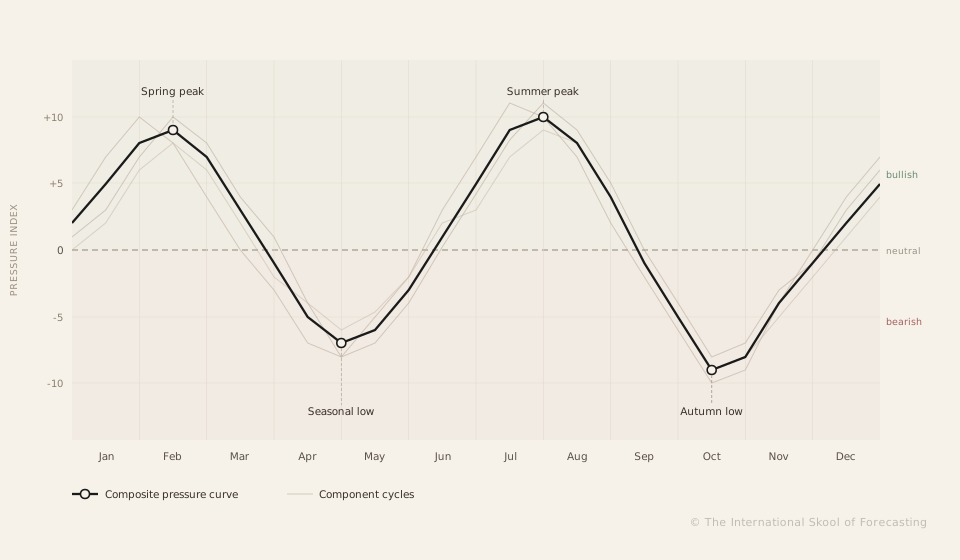
This is where the cycle stack becomes a forecast curve. The Mass Pressure Chart was Gann's overlay tool — he built each one by hand. I rebuilt it in a spreadsheet that updates with live Dow data. You set up the historical source data, construct the chart in the Forecast Roadmap tool, and watch the layered cycles resolve into one projected line for the year ahead. The chapter covers inversions, when to flip a cycle, and how to read the clustered peaks and troughs the layered chart produces.
The final chapter is my actual 2025 forecast, produced on camera across multiple sessions. You watch the entire workflow start to finish — from the look-back research, through each cycle horizon, through the Mass Pressure Chart construction, to the finished annual report. By the end you have seen exactly how the system produces a publishable forecast. You then produce your own for next year.
There are no student testimonials for this course yet. In their place, the three cases below are evidence the method deserves study — not a guarantee of future results. The first is from my 2024 forecast publication. The second is a historical illustration of the method across a real cycle. The third is the complete 2025 forecast I build on camera inside the course.
The call came from the look-back ladder and the mass pressure chart you build in the first half of this course — not from watching price. The 2024 forecast also covered the Dow Jones, gold, cryptocurrency, and the Australian market. The published forecast is what students see inside the course, used as a reference while you build your own. Same workflow. Same chart. Different year. It is one case in the record, not a promise that every window behaves the same way.
The market crashed into 2000 and bottomed in 2002. I show this case inside the course to demonstrate how the layered reading behaves across a real cycle — high prices, then a panic year, then a low. It is a teaching example drawn from the historical record, not a forecast the Skool published at the time. The point is the method: the same lookback ladder and decade-cycle reading you build for the year ahead.
You watch the entire workflow start to finish — the look-back ladder, the cycle stack construction, the mass pressure chart build, and the final report assembly. By the end you have seen exactly how the system produces a year-ahead forecast. You then build your own for the year after.
The rest of this letter handles objections and walks the offer. Some readers don't need either. The door is open.
AUD $9,997 · One payment · Lifetime access · NDA + identity verification
This is the objection any sophisticated researcher raises. Markets are faster than they were in 1929. Information moves in milliseconds. Quant funds run pattern recognition that wasn't possible when Gann was working. If the edge from a layered cycle method existed, surely it would already be priced in. The objection is real. You deserve a mechanism — not a reassurance.
Here is the mechanism. Algorithmic and quant strategies trade short horizons — milliseconds to days, occasionally weeks. The strategies that work over those horizons are pattern-recognition models trained on recent price action. None of them models the 18.6-year North Node cycle, the 20-year Jupiter–Saturn cycle, the 90-year cycle, or the multi-decade weather and political cycles Gann's annual forecast captured. Those cycles operate on horizons no quant fund can hold positions across. The edge isn't speed — it's time-scale. A forecast methodology working at the annual horizon doesn't compete with a model working at the millisecond horizon. They operate on different layers of the same market.
Central bank policy distorts stock index levels, but not the business cycle the index sits inside. From 2009 onward, QE and zero rates inflated the S&P above the underlying economic cycle's natural trajectory. The economic cycle kept running on its own schedule — weak wage growth, flat productivity, repeated non-financial recessions that never registered in the index. The forecast methodology tracks the underlying business cycle. The 2024 forecast hits weren't market timing trades; they were political, weather, and event-based calls drawn from the cycle stack. Those are exactly the calls that algorithms can't reach.
The forecast workflow doesn't pause between years. Each December I sit down with the Forecast Roadmap, run the look-back ladder, cluster the year's themes, layer the cycle stack, build the mass pressure chart for the year ahead, and write the report. The build takes weeks. It covers politics, weather, agriculture, the Dow, gold, cryptocurrency, and the Australian market — month by month.
Every December you don't have the workflow is another year reading someone else's forecast instead of building your own. Subscriptions renew. Years pass. The compounding asset is the workflow, not the subscription.
Build the workflow once and you produce forecasts for the rest of your research life. Your 2026 roadmap goes out next December. Your 2027 roadmap goes out the December after. Each one is built on the same method, refined a little each year as the historical record extends and the cycles complete. By the time you've built five annual roadmaps, you have a body of work — research output in your name, dated and on the record. None of that exists if you keep subscribing.
The workflow this course teaches took me more than fifteen years to assemble. The look-back research process, the cycle stack, the Mass Pressure Chart automation, the report-writing structure — each piece took years of work against the historical record. If I publish that workflow openly, any newsletter publisher can repackage it without attribution — and the work loses its value for every student who paid to learn it in full. The gate protects the research and the students already inside it.
Once you have built your first annual forecast, the workflow is yours permanently. No monthly fee. No renewal. You sit down each December with the Forecast Roadmap and produce next year's forecast — covering politics, weather, agriculture, the Dow, gold, cryptocurrency, the Australian market, whatever you choose to cover. The workflow is yours. No subscription owns it.
When you enrol, I ask for identity verification and an NDA covering the course materials and the research methodology. A person reviews each submission by hand. If verification cannot be approved, no access is released and we work with you directly to resolve it.
The refund clause: This is a strict no-refund program. Enrolment is final once you complete checkout. The verification step protects the research and the community, not your right to a refund — if verification cannot be approved, no access is released and we work with you directly to resolve it before any access opens. Read the terms before you enrol, because once you are in, the research is in your hands and we treat that transfer as final.
You aren't watching me write the forecast. You're learning the workflow and writing your own. Every output in one chapter becomes the starting point for the next — research file, cycle stack, decade-cycle anchor, Mass Pressure Chart, finished report.
I started with the published forecasts. Gann's 1929 annual report, the later ones, the scattered references in the Master Stock Market Course and 45 Years in Wall Street. The forecasts themselves were available. The workflow that produced them was not — not in Gann's own writing, not in Phil Anderson, not in Daniel Ferrera, not in any Gann-tradition book I read.
So I rebuilt it piece by piece. I studied chapter 7 of the Master Stock Market Course — what Frank Adam called Gann's greatest discovery. I worked through the decade cycle. I traced the 18.6-year North Node cycle in a modern ephemeris. I layered the 20-year Jupiter–Saturn cycle, the 30-year Saturn return, Benner, Armstrong, Bell, the 90-year cycle, the 100-year cycle. I worked out how each one weighted against the others at different phase positions.
Then I tackled the Mass Pressure Chart. Gann had built each one by hand from yearly Dow data going back decades. I automated it in a spreadsheet that updates with live data — what I now call the Forecast Roadmap. The first complete forecast I produced from the workflow was in 2017. I've produced one every December since. The 2024 forecast flagged a 120-year aviation cycle as a systemic failure risk; Boeing's crisis dominated the year. The 2025 forecast is the worked example in this course.
I built this course in 2023 because the workflow is too useful to keep private. Other researchers should be writing forecasts, not subscribing to mine. I teach the workflow the way I'd teach it to a serious research partner — every step, every tool, every decision.
The forecast starts with research, not with cycles. You learn the structured workflow I use to identify what's likely to define the year ahead — politically, economically, socially, agriculturally — from documented historical events. The same workflow Gann used to open every annual forecast he published. You finish this chapter with your research file for next year open.
From themes into the market. The chapter covers the long-period economic cycles other researchers have published — Benner, Armstrong, Bell, and others — alongside the planetary cycles Gann embedded inside his own published work. You walk each cycle against the Dow record back to the eighteenth century, learn which to weight at which phase, and start to see how the layered reading differs from any single-cycle line.
Frank Adam called the decade cycle the greatest discovery Gann ever made. Each year of the decade carries a characteristic pattern in price and economic activity — distinct enough that the pattern is readable on the Dow record going back to 1900. You learn to read each year's tendency and apply it as the anchor for your forecast of next year.
The Financial Timetable Gann compiled in 1908 covers a roughly 100-year economic cycle template. This chapter places the year you're forecasting inside that larger phase context — where in the long economic cycle the year sits. (My standalone Gann Financial Time Table course covers this cycle in deep detail. Here it slots into the larger forecast workflow as one input among many.)
This is where the cycle stack becomes a forecast curve. The Mass Pressure Chart was Gann's synthesis tool — built by hand, originally, from yearly Dow data going back decades. I rebuilt it in a spreadsheet that updates with live Dow data — the Forecast Roadmap. You set up the source data, construct the chart, and watch the layered cycles resolve into one projected line for the year ahead. The chapter covers inversions, when to flip a cycle, and how to interpret clustered peaks and troughs.
The master workflow produces a forecast on the Dow Jones. The same workflow translates to other markets — but each market has its own historical record, its own cycles that weigh more, and its own planetary tools that translate the master cycle stack into a market-specific forecast. This chapter covers gold, cryptocurrency, the Australian market, and the planetary tools (including the applying-vs-separating mechanics) that adapt the workflow to each.
The final chapter is my actual 2025 forecast, produced on camera across six sessions. You watch the entire workflow start to finish — the look-back research, the theme clustering, each cycle horizon, the Mass Pressure Chart construction, the asset-specific application, and the final report assembly. By the end you have seen exactly how the system produces a publishable forecast for a specific year. Then you produce your own for the year after.
Each chapter produces a working file you keep. The capability builds in sequence — after the research chapter you hold a structured file for next year. After the Mass Pressure Chart you hold a forecast curve for next year. After the worked example you've watched the whole workflow and you are ready to produce yours.
No student testimonials exist yet for this course. In their place, the two cases below stand on the record — my own 2024 forecast publication, and a historical illustration of the decade-cycle rhythm. You watch the same workflow produce the 2025 forecast inside the course.
My 2024 forecast. Published December 2023. It flagged a 120-year aviation cycle as a systemic failure risk — and Boeing's crisis dominated the year. The forecast also covered the Dow, gold, cryptocurrency, and the Australian market. The call came from the look-back ladder and the mass pressure chart you build inside the course. One case in the record, not a promise about the next year.
A historical illustration, not a live forecast. The decade-cycle rhythm and the financial timetable point to high prices late in the 1990s, then a panic window into 2000. The market crashed into 2000 and bottomed in 2002. I use this case inside the course to show how the layered reading behaves across a real cycle — the same lookback ladder you build for the year ahead.
Complete checkout via the secure page. Your enrolment goes into my manual review queue. You'll get a confirmation by email.
I ask for an NDA and identity verification to protect the materials and the research. A person reviews each submission by hand and I release your access once it is approved. If verification cannot be approved, no access is released and we work with you directly to resolve it.
Open the first chapter. You start the look-back research process for next year and the structured research file goes into your working folder. From there you move chapter by chapter — research, cycle stack, decade cycle, Financial Timetable, Mass Pressure Chart, asset applications, worked example — and finish with a complete annual forecast in your name.
No prior astrology knowledge required. The Cycle Stack chapter introduces the planetary cycles from first principles — what they are, how they move, why each one matters for the long-period economic cycle. The only tools you need are a free ephemeris database and a spreadsheet. The look-back research chapter starts the course with no astronomical data at all. The cycles enter when the baseline is in place.
It helps but it isn't required. The Financial Timetable chapter inside this course covers the 18.6-year cycle as one input among many — enough context to use it in the forecast workflow. If you want the deep dive on that single cycle — the recalibration correction, the hidden cycles inside the same columns, the 206-year master cycle — the standalone Gann Financial Time Table course covers all of that in detail. Many students take FTT first, then this course. Both work standalone.
Gann's books are public domain. The workflow this course teaches is not. The forecasts are public — the 1929 forecast PDF circulates among Gann researchers. What has never been published is the workflow from raw historical data to finished annual report. I rebuilt that workflow from the source over fifteen years and teach the full sequence here. The public-domain books give you pieces. This course gives you the working method.
Algorithmic strategies trade short horizons — milliseconds to days. They train on recent price action. None of them models the long-period cycles the annual forecast captures — the 18.6-year cycle, the 20-year Jupiter–Saturn cycle, the multi-decade weather and political cycles. Those cycles operate on horizons no quant fund can hold positions across. The edge isn't speed. It's time-scale. A research methodology working at the annual horizon doesn't compete with a model working at the millisecond horizon.
Yes. The complete 2025 forecast PDF is delivered as part of the worked-example chapter. You watch me build it on camera and you receive the finished report. The same forecast I distribute to my publication subscribers. Use it as a reference document while you build your own forecast for next year.
I built this course for independent researchers — people who study long-duration cycles as a research practice. No economics degree required. No Bloomberg terminal required. The tools are a free ephemeris, a spreadsheet, and publicly available historical data. The prerequisite is the discipline to do the look-back research and walk the cycles. If you've read Gann seriously and want to produce forecasts yourself, you're at the right threshold.
Three things. First, the complete workflow itself — the look-back research process, the cycle stack weighting, the Mass Pressure Chart construction, the report-writing structure — has never been documented in one place by Gann or by any researcher in the Gann tradition that I'm aware of. Second, the Forecast Roadmap spreadsheet automates the Mass Pressure Chart in a way Gann couldn't have done in 1908 — live data, easy inversions, cycle-by-cycle weighting. Third, the worked example: my complete 2025 forecast, produced on camera. No other Gann course shows the full workflow from raw data to finished report.
Realistically, weeks. The research, the cycle stack, the Mass Pressure Chart construction, the report assembly — each step takes time and the workflow is the work. The course is self-paced with no deadline. Most students complete the course material in six to twelve weeks and produce their first publishable forecast over the following month. Your working files are yours to keep and refine indefinitely.
This course teaches you to build forecasts, not to consume them. If you want a finished annual outlook delivered to your inbox without doing the work, there are subscription forecasts that provide them. This course is the workflow behind those forecasts — not a replacement subscription.
The forecast identifies turning windows measured in weeks and months, not specific entry days and prices. If you need a precise date and a precise price, this course won't serve you. The methodology works at the scale of years.
This is hands-on research work. The look-back research alone takes time. Building the Mass Pressure Chart takes time. Writing the report takes time. If you watch the lessons without doing the workflow, you leave with theory and no published forecast. The capability is in the working files. There is no shortcut.
This is a research education course. It isn't financial advice and I don't recommend any investment or trading position. If you're making an investment decision and need licensed guidance, consult a qualified financial adviser. I can't serve that need.
You learn the full workflow Gann used to publish his annual forecasts, build the Forecast Roadmap spreadsheet, watch the complete 2025 forecast assembled on camera, and produce your first publishable annual forecast — covering every category Gann covered. Then you do it again every December for the rest of your research life.
Seven chapters · The full workflow · 15+ cycles · The 2025 forecast as worked example
"Every December I sit down and build a full year-ahead forecast. The build takes weeks. The workflow took me fifteen years to assemble. The workflow is what I teach here — so other serious researchers can build their own roadmap instead of subscribing to mine." — Jonathan Evans
Enrollment process — After payment, complete a two-minute identity check via Stripe (government ID + selfie) and sign a non-disclosure agreement. Course access is issued after both are reviewed.
Strict no-refund · NDA and ID verification on enrolment
P.S. — The course gives you the full annual forecast workflow Gann used: the look-back research process, the layered cycle stack, the Mass Pressure Chart synthesis tool, the Forecast Roadmap spreadsheet, asset-specific applications, and my complete 2025 forecast built on camera as a worked example. One payment. No subscription. Yours for the rest of your research career. AUD $9,997 — Enrol now →
P.P.S. — Most researchers in this niche subscribe to someone else's forecast every December. The subscription renews. The years pass. After ten years, you've spent ten thousand dollars reading someone else's research. After ten years with the workflow, you've published ten annual forecasts in your own name — a body of dated, verifiable research output that compounds. The cost is the same. The asset isn't.
P.P.P.S. — If you're not willing to do weeks of research per forecast, this course isn't the right purchase. The forecast exists in the working files you build, or it doesn't exist. There is no pre-built version that arrives by email.